
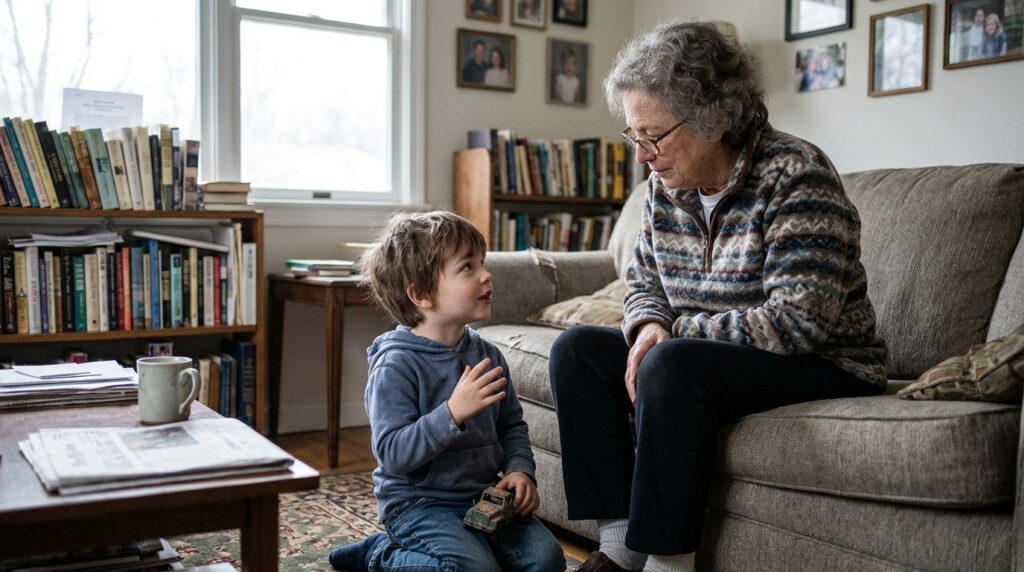
Across the globe, toddlers and young children occasionally astonish their caregivers by insisting they remember a life that took place before they were born. While such remarks are often brushed aside as imaginative play, a new paper published on Zenodo by researcher Otto examines nearly six decades of formal academic documentation surrounding the phenomenon, contrasting it against the robust psychological mechanisms that govern human recollection.
The Decades-Long Record of Childhood ‘Recollections’
The paper centers on an unusual body of empirical work: nearly sixty years of documented reports preserved in the archives of the University of Virginia’s Division of Perceptual Studies and its affiliated research programs. Over decades of field investigation, researchers systematically transcribed statements made by small children claiming spontaneous episodic memory of previous identities, deceased family members, or distant communities, subsequently checking these claims against historical and public records.
According to the study, recurring behavioral and narrative patterns emerge across these international case files. Rather than existing in an intellectual vacuum, these modern accounts mirror an ancient cultural lineage. The author traces similar narrative traditions back thousands of years—referencing ancient Greek accounts including Pythagoras and Plato’s Myth of Er, alongside early Buddhist, Zoroastrian, and Vedic texts where personal recollection across time formed a foundational concept.
The Counter-Weight: Suggestion and Memory Malleability
Despite the intriguing correlations found in archive cases, the paper places substantial weight on mainstream cognitive science, setting established psychological counterarguments alongside anecdotal testimonies. Decades of laboratory research demonstrate that human memory does not operate like an indelible video recording; rather, it is governed by reconstructive memory processes that assemble past events using current knowledge, expectations, and social context.
The author highlights how heightened childhood suggestibility, well-meaning parental questioning, and culturally available scripts can inadvertently guide a child’s imagination into a structured narrative. Furthermore, phenomena such as cryptomnesia—where a person unconsciously retrieves forgotten information and mistakes it for an original memory—provide plausible psychological avenues for how mundane overheard facts can evolve into convincing claims of a former existence.
Agnosticism, Not Dogma, Guides the Scientific Takeaway
Rather than declaring proof of metaphysical claims or dismissing the reports outright as pure fantasy, the paper highlights the explicit scientific agnosticism maintained by the archival researchers themselves. The author quotes these researchers directly, emphasizing that responsible scientific inquiry resists premature conclusions when data resists neat categorization.
Ultimately, the paper frames its takeaway around open questions regarding human consciousness, cognitive tuning, and the cultural frameworks that shape our self-concept. By contrasting rigorous documentation with the known pitfalls of cognitive malleability, the study invites multidisciplinary and community-driven dialogue to explore how memory, culture, and perception intertwine when people interpret extraordinary experiences.
Source
- The People Who Believe They Are Remembering Ancient Things
- Researchers: Otto
- Journal: Zenodo (CERN European Organization for Nuclear Research)
- Read the original study