
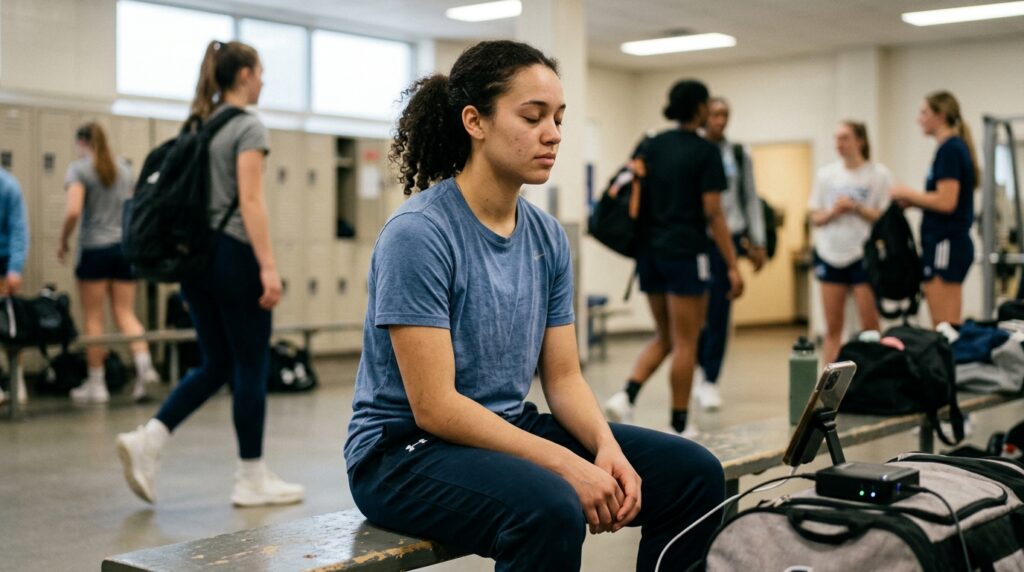
As sports organizations increasingly deploy automated systems to optimize athletic performance, new psychological research highlights a hidden emotional toll of continuous digital surveillance. According to a study published in the journal Acta Psychologica, collegiate athletes subjected to artificial intelligence (AI) coaching without psychological support experienced significant increases in stress and algorithmic reliance over time—though integrating concurrent mindfulness training proved capable of neutralizing the strain.
The Hidden Psychological Cost of Algorithmic Coaching
Artificial intelligence is rapidly transforming sports training, providing athletes with instantaneous metric tracking, biomechanical analysis, and real-time guidance. Yet the constant gaze of algorithmic scrutiny carries an unexpected psychological price. Grounded in the transactional model of stress, the study—led by researcher Wei Zhang and colleagues—found that collegiate competitors who trained under automated performance tracking without mental health support showed notable increases in perceived stress over time.
Beyond elevated stress markers, the researchers observed a parallel rise in AI dependence among unassisted participants. When athletes receive continuous, automated feedback without guidance on how to process it psychologically, they risk developing an unhealthy reliance on algorithmic validation, feeling uneasy or incapable when detached from algorithmic metrics.
Mindfulness Acts as a Critical Buffer
Fortunately, the study demonstrated that targeted mental exercises can shield athletes from digital burnout. Competitors who paired AI-assisted training with regular mindfulness practices experienced substantially attenuated stress levels across an eight-week training period, blunting the adverse impacts seen in the unsupported group.
Mediation analyses showed that mindfulness interventions achieved this buffering effect primarily by bolstering mindful awareness—the capacity to maintain present-moment, nonjudgmental attention. Furthermore, a three-wave cross-lagged analysis revealed a reciprocal dynamic over time: as mindful awareness deepened, perceived stress decreased, reinforcing an ongoing protective cycle that helped athletes stay grounded despite relentless algorithmic feedback.
Inside the Eight-Week Experiment
To evaluate the psychological impact of digital coaching, the research team followed 160 collegiate athletes over an eight-week timeline. Using a randomized controlled factorial design, participants were divided into AI-assisted or standard athletic training regimens, both with and without a concurrent mindfulness program.
Assessments conducted at baseline, week 4, and week 8 captured how psychological responses evolved over time. The findings revealed that continuous algorithmic monitoring introduces a distinct form of evaluative pressure. Because software evaluates performance without empathy or context, athletes interpret algorithmic readouts as relentless judgment, creating a strain that requires deliberate, active coping strategies.
Why Human Support Must Accompany AI Adoption
While the study demonstrates clear psychological benefits for collegiate competitors, the authors emphasize that further investigation is needed. Future research will be necessary to evaluate long-term outcomes over multiple competitive seasons and to explore how athletes across diverse skill tiers and elite divisions handle algorithmic oversight.
Nonetheless, the practical implications for coaches, trainers, and sports administrators are immediate. Deploying continuous algorithmic tracking systems without psychological buffers risks overwhelming athletes and eroding their confidence. For sports programs embracing the future of technology, pairing cutting-edge AI analytics with structured mental wellness training is no longer an optional perk—it is an essential safeguard.
Source
- Psychological consequences of AI-assisted training and the buffering role of mindfulness
- Researchers: Wei Zhang, Zhihao Zhang, Pengcheng Chang, Qiuhan Zhu, Du Wang
- Journal: Acta Psychologica
- Read the original study