
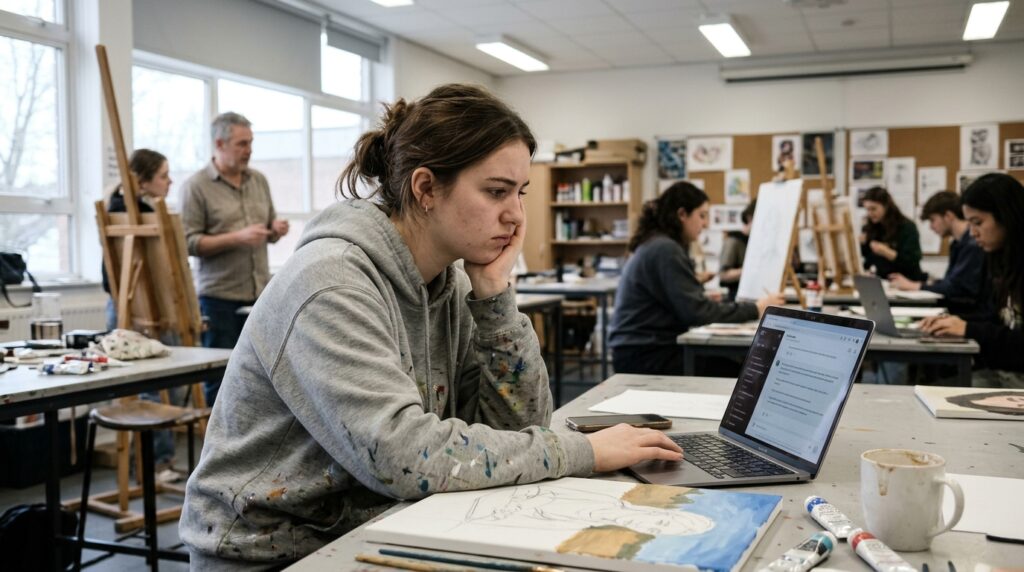
Generative artificial intelligence offers students instant ideas, feedback, and solutions, but delegating too much mental heavy lifting to algorithms may come at a steep creative cost. According to a study published in the journal Frontiers in Education, leaning heavily on automated tools to handle core analytical and conceptual tasks can disrupt the classroom dynamics that foster student innovation. When learners allow technology to take over their thinking, the constructive impact of supportive teaching on original work can effectively vanish.
The Paradox of Offloading Thoughts to AI
In traditional educational environments, encouraging instructors provide the guidance and psychological scaffolding needed to cultivate inventive problem-solving. However, researchers Li Gong and Xiaohui Li discovered that excessive reliance on digital assistants can disrupt this collaborative dynamic.
The authors describe this dilemma as the “AI cognitive substitution paradox.” While automated tools are designed to streamline workflows and enhance efficiency, relying on them to replace genuine mental effort creates counterproductive results. Rather than augmenting human capability, substituting technology for fundamental critical and imaginative processes can neutralize the creative spark that educators work diligently to nurture.
The Critical Role of Student Autonomy
To understand why this breakdown happens, the researchers examined the motivational mechanisms that translate classroom encouragement into creative achievement. Their analysis revealed that perceived autonomy—a student’s personal sense of agency and independent control over their learning process—serves as the primary bridge connecting instructional mentorship to novel output.
Under ordinary circumstances, a mentor’s guidance strengthens a learner’s self-directed confidence, which in turn fosters higher levels of artistic and conceptual creativity. Yet when cognitive substitution surpasses a critical tipping point, this pathway deteriorates. The study demonstrated that heavy technical delegation weakens both how effectively instructor guidance builds autonomy and how strongly that autonomy translates into original creative work.
How the Study Tested the AI Substitution Effect
The research team evaluated their hypotheses using a sample of 324 art students. To measure both subjective experiences and practical outcomes, the authors combined comprehensive questionnaire surveys with objective expert assessments of the participants’ finished creative projects.
Using a moderated mediation model, the investigators examined how varying degrees of cognitive replacement influenced the link between teacher support, student autonomy, and creative performance. The findings revealed that for students who routinely let algorithms solve conceptual problems and drive project choices, the positive indirect benefits typically provided by teacher guidance were significantly weakened or rendered statistically null.
Educational Takeaways and Next Steps
The researchers emphasize that their conclusions are exploratory and limited to art students, whose creative procedures may differ markedly from other fields. Consequently, the team calls for further research to determine whether the AI cognitive substitution paradox operates identically in disciplines such as engineering, natural sciences, and the humanities.
Rather than suggesting a blanket ban on modern classroom technology, the findings highlight the need for thoughtful integration. Instructors and academic institutions must help students navigate digital tools as collaborative, assistive resources rather than outright replacements for personal problem-solving, preserving the intellectual independence necessary for genuine innovation.
Source
- The paradox of AI cognitive substitution: a moderated mediation model of the relationship between teacher support and student creativity
- Researchers: Li Gong, Xiaohui Li
- Journal: Frontiers in Education
- Read the original study